
Indiana Divorce Decree Records
Indiana divorce decree records are court documents held by the Circuit Clerk in each of the state's 92 counties. You can search basic case information online, but certified copies of a divorce decree must come directly from the county clerk where the divorce was filed. Each county keeps its own files, so you need to know where the divorce took place before making a request. This guide covers how to find Indiana divorce decree records, what steps to take, and where to go when you need a certified copy.
Indiana Divorce Decree Quick Facts
Where to Find Indiana Divorce Decrees
The Circuit Clerk in each Indiana county is the official keeper of all divorce case files. This includes the original petition for dissolution of marriage, responses from both parties, any motions or temporary orders issued during the case, and the final divorce decree signed by the judge. The clerk's office stores these records permanently and can make copies for anyone who submits a proper request. You must contact the clerk in the county where the divorce was filed, not where either party lives today.
Indiana Courts runs a public case search portal where you can look up basic information about a divorce case by name or case number. This tool is free and open at any time. It shows case numbers, party names, hearing dates, and case status. But you cannot download the divorce decree itself from this portal. It gives you information to help you identify the case; the county clerk provides the actual certified document. Start a case search at public.courts.in.gov/mycase/.
The Indiana Judicial Branch public records guide explains how to request court documents, what forms to complete, and what fees to expect. It covers all types of court records and is a useful starting point for anyone unfamiliar with the process. Indiana's Access to Public Records Act, found in Indiana Code 5-14-3, gives any person the right to inspect and copy public records held by government agencies, including county courts. You do not need to explain why you want the record.
For older divorce decrees from before the 1990s, records may have been moved to archive storage. The Indiana State Archives at 6440 E. 30th Street in Indianapolis holds historical materials from county courts across the state. Call (317) 591-5220 to check whether older records from a specific county are stored there. Some counties have also transferred old probate, civil, and court records to state archives or local history collections.
How to Search Divorce Decree Records in Indiana
Start at public.courts.in.gov/mycase/ to search by the full name of either party. You can narrow results by county and date range if you know those details. The system covers cases from all 92 Indiana counties and goes back to the 1990s in most jurisdictions. Results show the case type, case number, filing date, and court events. Once you find the right case, note the case number and the county. You will need both when you contact the clerk.
After confirming the county through MyCase, call or visit that county's Circuit Clerk to request a certified copy of the divorce decree. Most clerks accept in-person visits, mail requests, and some take requests by phone or email. You will need the full names of both parties and, if possible, the case number. Bring a valid photo ID. Many clerks require identification before releasing certified copies of court documents. Indiana Code 5-14-3 allows access to public records, but certified copies go through the clerk's standard process.
Indiana also has a Self-Service Legal Center with forms, guides, and answers to common questions. This is helpful if you need the decree for a new legal matter or need to understand what steps come next.
Indiana Divorce Decree Documents Explained
A divorce decree is not the same as a divorce certificate. The decree is the court order that ends the marriage. A judge signs it and files it with the county clerk as a permanent record. The decree states when the marriage ended and sets out specific terms: who receives which property and debts, custody of children, visitation schedules, and any support obligations. Most legal and financial matters that involve a prior divorce require the actual decree, not just proof that a divorce took place.
Indiana divorce case files often contain many documents beyond just the final order. Common items include the petition for dissolution of marriage, the other party's response, financial disclosure forms, any temporary orders for custody or support while the case moved through court, settlement agreements if both sides agreed on terms, and the final signed decree. You can request copies of any individual document or the entire case file from the county clerk. Copy fees under Indiana law are $1.00 per page, with a $3.00 certification fee per document added since July 1, 2021.
Indiana Code 31-15-2-6 sets residency rules: at least one spouse must have lived in Indiana for six months before filing, and in the county for three months. These requirements determine where a case can be filed and help you figure out which county clerk holds the record you need. If you are unsure which county handled the divorce, a search at MyCase Indiana across all counties can help you locate it.
The Indiana Courts marriage records lookup at public.courts.in.gov/marriagelookup/ shows marriage license records from 1993 forward. This is a separate tool from the case search. It can help confirm a marriage date if you need that information alongside a divorce record.
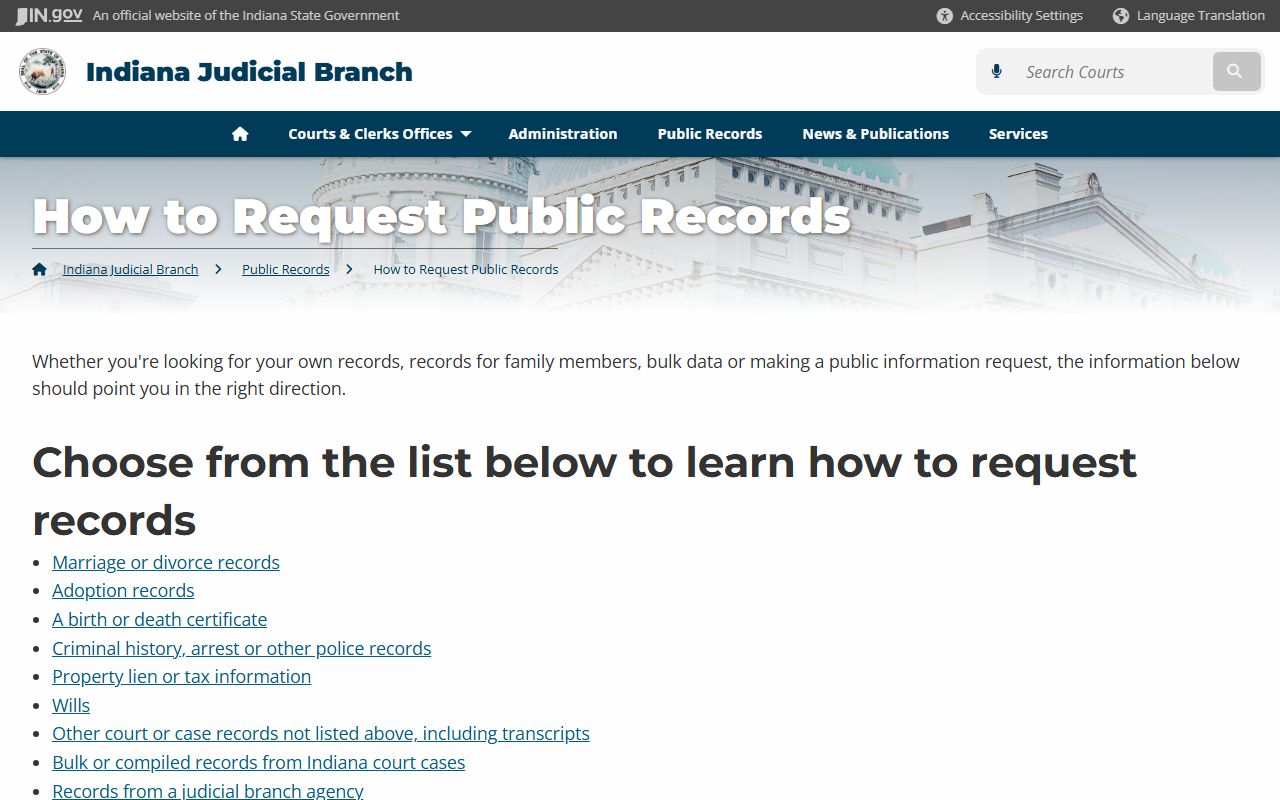
The Indiana Courts public portal provides case information for divorce and other court matters. Basic case details are visible without charge, but you must contact the county clerk directly to receive a certified copy of any divorce decree.
Indiana Divorce Laws and the Decree Process
Indiana law governs how divorce cases move through the court system and what records are created along the way. Once a petition for dissolution of marriage is filed, Indiana Code 31-15-2-10 requires a 60-day waiting period before the court can grant the final decree. The waiting period runs from the date the petition is filed, not the date it is served on the other party. During this time, the court can issue temporary orders covering who uses the family home, how bills are handled, and who has physical custody of children while the case is pending.
Indiana is an equitable distribution state under Indiana Code 31-15-7. This means the judge divides marital property and debts in a fair way, though not necessarily an equal one. The divorce decree will spell out what each party receives, including real estate, vehicles, bank accounts, retirement assets, and debts. Both parties are bound by the terms of the decree once the judge signs it. Any change to the final terms requires a separate legal motion and a court hearing.
Some cases involve a marital settlement agreement where both sides agree on all terms before the final hearing. In those cases, the judge reviews the agreement and signs a decree that adopts the agreed terms without a contested hearing. Other divorces go through contested hearings where a judge resolves disputed issues after reviewing evidence and testimony. Either way, the final signed decree becomes a permanent public record held by the Circuit Clerk in the county where the case was heard.
Fees for Indiana Divorce Decree Copies
Copy fees across Indiana courts follow a statewide standard. Most clerks charge $1.00 per page for photocopies of court documents. Certified copies carry an additional $3.00 certification fee per document, which took effect July 1, 2021. A one-page certified decree costs $4.00. A ten-page certified decree costs $13.00. Individual county clerks may have minor variations, so it is worth a quick call to confirm before you send a mail request or make a trip to the courthouse.
Filing for divorce in Indiana costs more than requesting a copy of an existing decree. Filing fees for a new dissolution of marriage case typically range from $157 to $177 in many counties, and can go higher depending on whether children are involved or what local fees the county charges. These are the costs to start a new case, not to get a copy of a past decree.
Payment methods vary by county. Most offices accept cash, money orders, and cashier's checks. Some accept credit and debit cards but charge a convenience fee, often around 3%. Personal checks are not accepted at many Indiana clerk offices. Cass County, Noble County, Greene County, and others specifically prohibit personal checks. If mailing a request, use a money order or cashier's check. Include a self-addressed stamped envelope so the clerk can return copies to you.
Note: Fee schedules can change. Always confirm current fees by calling the clerk's office before you submit your request.
Who Can Access Indiana Divorce Decree Records
Indiana divorce decree records are public under Indiana Code 5-14-3, the Access to Public Records Act. Any person can visit a county clerk's office and request a copy of a divorce decree. You do not need to prove a relationship to the parties or give a reason for the request. The clerk will search for the record and make a copy for the standard fees. Basic case information is also available to anyone at no charge through MyCase Indiana.
Some portions of divorce case files may be restricted or redacted. Financial account numbers, social security numbers, and records relating directly to minor children may be removed from public copies. In rare cases, a judge may order an entire divorce case file sealed. Sealed records are not available to the public without a court order. The Indiana Rules on Access to Court Records govern what information stays public and what may be restricted.
Genealogy researchers, legal professionals, and the general public all access Indiana divorce records under the same rules. Bring valid photo identification to the clerk's office, know the county where the case was filed, and have the names of both parties or a case number ready. This speeds up the search considerably, especially for older records that may require staff time to locate.
Legal Help for Indiana Divorce Cases
Indiana Legal Help at indianalegalhelp.org provides free legal information for people handling divorce matters on their own. The site has plain-language guides for completing dissolution forms, understanding what to expect in court, and knowing your rights regarding property and children. Resources are available in both English and Spanish. This is not a law firm and does not give legal advice, but the guides are written in clear terms that anyone can follow.
The Indiana Courts Self-Service Legal Center at public.courts.in.gov/selfservice/ has approved court forms for dissolution of marriage and related proceedings. You can download and complete these forms before visiting the courthouse. Using official state forms reduces the chance of having a filing returned by the clerk. The center also includes instructional materials and links to local court resources across Indiana's 92 counties.
Some county clerks post local divorce forms directly on their websites. For example, the Boone County Clerk lists available divorce forms online and notes that all cases since August 1993 can be searched at judici.com. The Allen County Clerk accepts copy requests by email at copyrequest@co.allen.in.us and by phone at 260-449-7890. If you are not sure where to start, the county pages on this site list clerk contact information, addresses, and hours for every Indiana county.
Browse Indiana Divorce Decrees by County
Each of Indiana's 92 counties has a Circuit Clerk who keeps all divorce decree records for that county. Select a county below to find local contact details, addresses, hours, and resources for requesting divorce records in that area.
Indiana Divorce Decree Records in Major Cities
Residents of larger Indiana cities file for divorce at their county Circuit Court. Select a city below to find information specific to divorce decree records in that area.