
Find Divorce Decrees in Allen County
Allen County divorce decree records are maintained by the Allen Circuit and Superior Courts Clerk in Fort Wayne, Indiana. The clerk's office handles all official divorce case files for Allen County, including the final decree documents issued by the court. You can search for case information online through Indiana's MyCase system, but to get a certified copy of an Allen County divorce decree, you must contact the clerk's office directly by phone, email, or in person.
Allen County Quick Facts
Allen County Clerk of Courts Office
The Allen County Clerk is Christopher M. Nancarrow, who serves as the Clerk of the Allen Circuit and Superior Courts. As the official records custodian for all trial court cases in Allen County, his office processes all divorce filings and maintains the final decrees. The research notes that "The Clerk administers the official court records for all trial court cases with jurisdiction in Allen County, prepares the permanent historical records for the courts, processes and issues various documents for court cases, and is responsible for more than $107 million in financial transactions annually." That volume reflects just how large Allen County's court system is compared to most Indiana counties.
| Office | Allen Circuit & Superior Courts Clerk |
|---|---|
| Clerk | Christopher M. Nancarrow |
| Address | Allen County Courthouse, 715 S. Calhoun Street, Room 200A, Fort Wayne, IN 46802 |
| Copy Requests | Room 201 (Central Services Division) |
| Phone | (260) 449-7245 |
| Central Services | (260) 449-7890 |
| Fax | (260) 449-7658 |
| copyrequest@co.allen.in.us | |
| Hours | Monday - Friday, 8:00 AM - 4:30 PM (Copy requests: 8:00 AM - 4:00 PM) |
| Website | allencountyclerk.in.gov |
For copy requests specifically, go to Room 201 (Central Services Division) at the Allen County Courthouse. This is different from the main clerk's office in Room 200A. You can also reach Central Services by phone at (260) 449-7890 or email copyrequest@co.allen.in.us. The obtain copies of records page on the clerk's website explains the full process.
How to Search Allen County Divorce Records
Start with Indiana's MyCase public case search. MyCase lets you look up divorce cases filed in Allen County by name or case number. You can see filing dates, hearing schedules, and case status. What you cannot do is download or print the actual divorce decree through MyCase. The site also notes that "information about dates of marriage and divorce may be searched online, but marriage licenses or certificates are not available for these records." The same applies to divorce decrees themselves.
Allen County also has its own court website at allencountycourt.org, which includes a public records section with more detail on how to request documents.
For older records, note that Allen County Archives holds records more than 20 years old. Call the archives at (260) 449-7671 for help locating historic divorce decrees.
Requesting a Certified Allen County Divorce Decree
Allen County offers several ways to request a certified copy of a divorce decree. You can visit the Central Services Division at Room 201 in person, send an email to copyrequest@co.allen.in.us, or mail a written request to the clerk's office. As the clerk's office confirms, "Copies of marriage records and divorce records can be requested from the Clerk of Courts." There is also an online form available through the clerk's website for those who prefer a digital request. Visiting in person is still the fastest option. Same-day or next-business-day turnaround is typical for walk-in requests.
For mail requests, allow 1 to 5 business days depending on the current backlog. Include the full names of both parties, approximate divorce date, case number if known, and a self-addressed stamped envelope. Payment by money order or cashier's check is safest for mail submissions.
Note: Call (260) 449-7890 or email copyrequest@co.allen.in.us to confirm current fees before sending a mail request.
Allen County Divorce Decree Fees
Allen County charges a $5.00 search fee per name searched. Copy fees are $1.00 per page. Certification of a document costs $1.00 per document. So if your divorce decree is 3 pages, the total comes to $3.00 for copies plus $1.00 for certification, plus the $5.00 search fee if staff needs to locate the record. These are the rates specific to Allen County and differ slightly from the standard statewide model used by smaller counties. Always confirm exact amounts before your visit or mail submission since fees can change.
Allen County Courts and Indiana Divorce Law
Allen County is home to Fort Wayne, Indiana's second-largest city, with a population of roughly 260,000. The Allen County Circuit and Superior Courts handle all divorce filings for this large jurisdiction. Under IC 31-15-2-6, at least one spouse must reside in Indiana for six months and in Allen County for three months before filing. This residency rule is why the Allen County clerk's office holds the records for divorces of Fort Wayne and Allen County residents specifically. For those wondering which county their divorce was filed in, the MyCase statewide search can help narrow it down.
Indiana also requires a 60-day waiting period under IC 31-15-2-10. After filing, a court cannot finalize the divorce until at least 60 days have passed. The final divorce decree is what the clerk's office stores and what you would request a certified copy of. The Indiana Courts Self-Service Legal Center has forms and guides for people handling divorce cases without an attorney.
Public Access to Allen County Divorce Records
Indiana Code IC 5-14-3, the Access to Public Records Act (APRA), makes most Allen County divorce case files public record. Anyone can request to inspect or copy a divorce decree. You do not need to be a party to the case to get basic case documents. That said, some portions of divorce records are not public. Financial affidavits, child custody evaluations, any records containing Social Security numbers, and sealed case files are exempt from public access under Indiana law.
The Allen County Clerk's FAQ confirms this: "Yes, court divorce case files are generally available for public inspection under the Indiana Access to Public Records Act, with certain exceptions for financial affidavits, child custody evaluations, and sealed records." If you want a certified copy specifically as proof of divorce, the clerk's FAQ also notes: "You must obtain a certified copy of the divorce decree from the Clerk of the Allen Circuit and Superior Courts."
The Indiana courts public records request page has more detail on the statewide process and what to expect when you make a request.
The Allen County Clerk's website is a reliable starting point for any divorce decree request in Allen County.
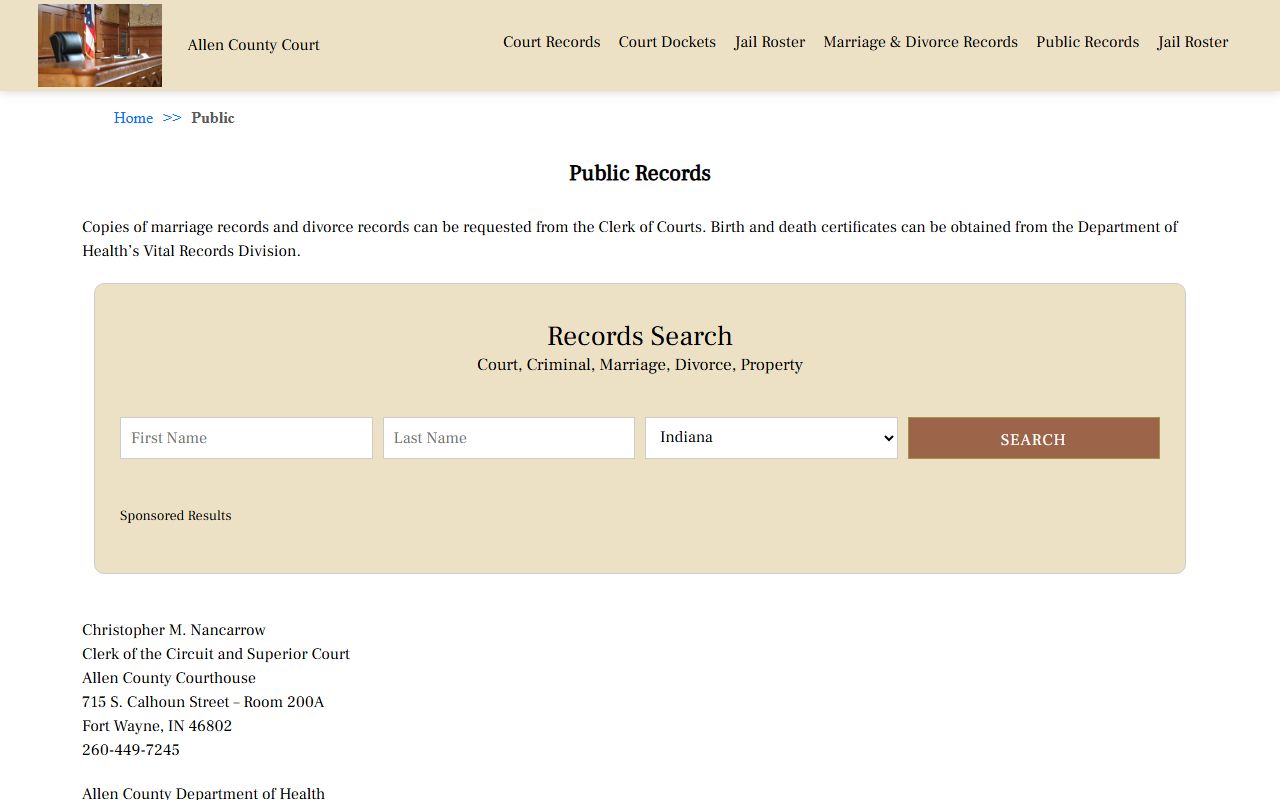
Allen County's clerk office in Fort Wayne serves one of Indiana's largest court jurisdictions, processing thousands of divorce cases each year.
Legal Help for Allen County Divorce Cases
The Indiana Courts Self-Service Legal Center provides dissolution of marriage forms and instructions for free. This is especially useful if you are filing without an attorney. The Indiana Legal Help website connects Allen County residents with free or low-cost legal assistance. These resources can help you understand the process, fill out forms correctly, and know what to expect from the court. Legal aid organizations in the Fort Wayne area may also offer in-person help for qualifying low-income residents.
Cities in Allen County
Fort Wayne is the county seat and the largest city in Allen County, home to roughly 260,000 residents. Other communities in Allen County include New Haven, Grabill, Huntertown, Leo-Cedarville, and Woodburn. All Allen County divorce decrees are filed with and maintained by the Allen County Clerk regardless of which city or township the petitioner lives in. Fort Wayne does not have a separate city page on this site, but all divorce records for Fort Wayne residents are held at the Allen County Courthouse.
Nearby Counties
Allen County shares borders with several northeast Indiana counties; each handles its own divorce decree filings independently.